


- Home>
- Generative Ai
Generative AI Development Company
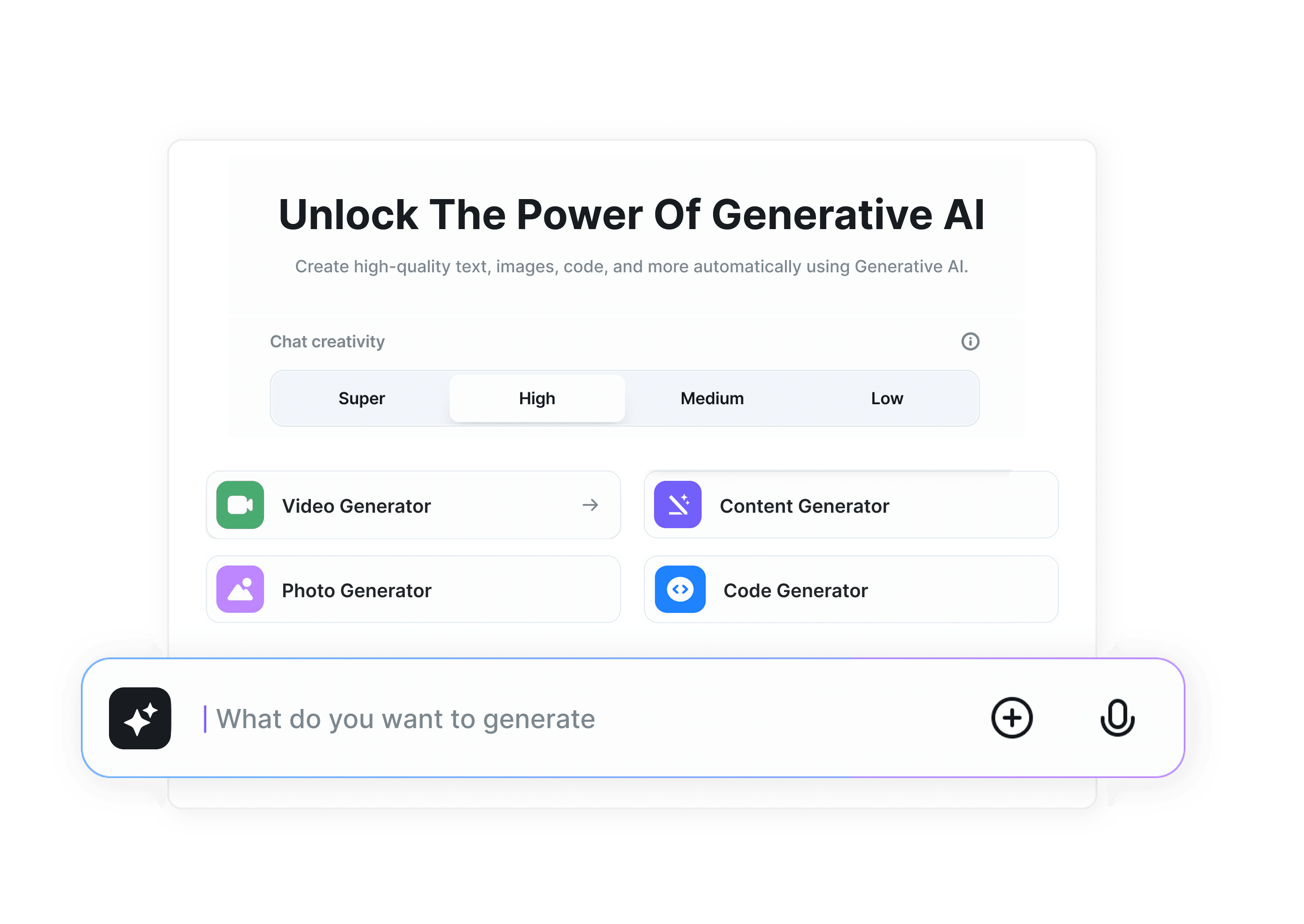
Bitontree builds custom generative AI into products and operations, then runs it after launch. Our embedded engineering teams handle the full lifecycle: scoping the use case, deciding between prompting, RAG, and fine-tuning, shipping to production, and monitoring quality once real users arrive. Founded in 2019, we are a team of 40+ engineers who treat generative AI as production software, with the evals, security, and cost controls that implies.
Generative AI Development Services We Provide
Generative AI development is the engineering work of building, adapting, and integrating AI models that produce text, images, audio, or code into production software. That is the work we do. We design generative systems around your data and workflows, decide where prompting ends and RAG or fine-tuning begins, and integrate the result into the tools your team already uses. Every build ships with evaluation, monitoring, and security in place, and we keep running it after launch.

Generative AI Consulting
We help you pick the use cases worth building and drop the ones that are not. That means auditing your data, mapping workflows, and recommending an approach (prompting, RAG, fine-tuning, or a custom model) before any code gets written. You leave with a roadmap grounded in what your data can actually support.

Generative AI Model Development
We build custom generative models and pipelines around your data, workflows, and industry constraints. Each one is tested against real production cases rather than toy benchmarks, and tuned for the accuracy, latency, and cost profile your use case demands. Custom builds get you behavior an off-the-shelf API cannot deliver.

LLM Model Fine-Tuning
When prompting and retrieval stop being enough, we fine-tune commercial and open LLMs on your domain data. The result speaks your business language, follows your formats, and holds accuracy on the edge cases generic models miss. We will also tell you when fine-tuning is overkill, because often it is.

Prompt Engineering & Optimization
We design, version, and regression-test prompts the way other teams treat code. Structured prompt suites with automated evals catch quality drift before your users do, which keeps output reliable as models change underneath you and requirements shift on top.

Generative AI Integration
We wire generative capabilities into your existing apps, platforms, and workflows through clean APIs and event-driven architecture. No rip-and-replace. Your CRM, ERP, or product backend keeps working while AI takes over the steps that used to need a person.

Generative AI Model Replication
Once a generative system proves out in one domain or market, we adapt it for the next: new data, new language, new compliance constraints, same proven architecture. This is the fastest route to scaling AI across an enterprise without rebuilding from zero each time.
Generative AI Models We Work With
As a Generative AI Development Agency, we stay deliberately model-agnostic. The model is one piece of the system; retrieval, orchestration, evaluation, and integration do most of the work. We pick the architecture that fits your data, latency, privacy, and cost constraints, and we design every build so the model layer can be swapped when a better fit ships.

GPT-5
We use GPT-5 and the wider OpenAI family for reasoning-heavy work: copilots, conversational support, document analysis, and structured content generation. Strong general capability and mature tooling make it our usual starting point for text workloads.

Deepgram
Deepgram handles speech-to-text in our voice systems: call analysis, transcription pipelines, and real-time voice agents. We pair it with LLMs to turn raw audio into structured, searchable data your team can actually act on.

Llama
Llama is our pick for self-hosted and fine-tuned deployments where data cannot leave your infrastructure or you need full control of the model weights. We tune it on domain data for chatbots, internal tools, and knowledge assistants.

Stability AI
Stability AI models generate production-quality images from text for design workflows, marketing assets, and product visualization. We build the pipeline around them: prompt templates, brand constraints, and human review where it matters.

Google Vision AI
Google Vision AI covers the perception side: detecting objects, text, and patterns in images and documents. We combine it with generative models for document processing, content moderation, and visual data extraction at scale.

DALL-E
DALL-E turns text descriptions into detailed visuals for branding, advertising, and creative production. We reach for it when fast iteration on concepts matters more than fine-grained style control, and it shortens design turnaround considerably.
Featured Projects
A few of the generative AI systems we have shipped and still run for clients today.


LogisticsSingapore: 
Smart AI Invoice Processing System
AI-powered invoice processing for a Singapore-based logistics enterprise. OCR and ML automate data extraction, validate against business rules, and process invoices end-to-end across multiple formats and currencies.
PythonLangGraphCrewaiStreamlitAzure
Use Cases of Generative AI Development
These are the generative AI use cases we build most often. The pattern is consistent: take a workflow that burns skilled hours producing repetitive output, ground a model in your data, and ship it with review steps and monitoring so quality holds up in production.

Medical Image Synthesis for Diagnostics
We build image synthesis systems that support radiology workflows: improving image clarity, filling data gaps, and simulating rare cases for training. Synthetic imaging lets clinical teams study presentations they rarely encounter in practice. Everything we build for healthcare is HIPAA aware from the first commit.

Content Creation and Ad Campaigns
Generative systems that produce marketing copy and ad creative variations in your brand voice, at the volume real campaign testing requires. Teams go from one concept to dozens of on-brand variants without adding headcount, and human approval stays in the loop before anything ships.

Document Intelligence and Knowledge Extraction
Pipelines that read contracts, policies, invoices, and reports, then return summaries, structured data, and answers with citations. Manual review effort drops, and decisions stop waiting on someone to dig through a shared drive. We run a system like this in production for a logistics enterprise in Singapore.

Voice Cloning and AI Voice Assistants
Natural, multilingual synthetic voices for virtual assistants, IVR systems, and digital content, with tone control and a consistent brand personality across channels. We have run this stack in production for patient-facing medication reminder calls in US healthcare, where the voice has to sound human and the system has to work every day.

Product Design and Concept Generation
Models that generate product ideas, designs, and variations from your requirements and market signals. Ideation speeds up, and teams validate concepts earlier in the cycle, so R&D effort goes to the directions that survive scrutiny instead of the ones that merely came first.

AI-Powered Customer Support
Context-aware support across chat, voice, and self-service, grounded in your own help content so answers stay accurate. Escalation rules route the hard cases to humans, which means the AI absorbs the volume and your team keeps the judgment calls. Customers get answers at 2 a.m. without you staffing for it.
Why Choose Bitontree for Gen AI Development Services?
Bitontree has been building software since 2019, with a team of 40+ engineers and generative AI systems running in production across healthcare, logistics, ecommerce, and SaaS. The operating model is what sets the work apart: we embed in your team, build the system, and keep running it after launch. Many agencies hand over a repo and move on. We stay accountable for the thing in production.
Expertise in Advanced AI Models
We work hands-on with current frontier and open model families and re-evaluate them constantly, because the leaderboard changes every quarter. Your system gets the model that fits the job today, built on an architecture that lets you swap it tomorrow without a rewrite.
Industry-Leading Experts
Our engineers have shipped machine learning, NLP, and image generation systems into real production environments: hospitals, logistics enterprises, ecommerce stores. That experience shows in the unglamorous parts, like evals, fallbacks, and cost controls, which is where most generative AI projects actually fail.
Client-Centric Focus
We start from your business objective and work backwards to the technology. After mapping your workflows and pain points, we recommend the smallest system that solves the problem, and we have talked clients out of builds they did not need.
End-to-End Support
Our engagement covers model development, integration, deployment, and the long tail after launch: monitoring output quality, retraining on new data, and adapting the system as your business changes. Production AI degrades without attention. Ours gets attention.
Commitment to Quality and Innovation
Every system ships with automated evaluations, regression tests for prompts, and drift monitoring. We hold generative AI to the same engineering bar as any other production software, because for your users that is exactly what it is.
Industries We Build Generative AI For

Healthcare
We build AI systems for healthcare practices and hospitals: patient intake automation, medication adherence calling, clinical documentation, and scheduling agents. Every system is engineered inside HIPAA controls, with BAAs signed and integration into Epic, Cerner, and Athena via FHIR.

E-commerce
Our AI agents help ecommerce businesses on Shopify, WooCommerce, Magento, and BigCommerce recover abandoned carts, personalize product recommendations, automate order tracking, and retain customers. Each system integrates directly with your storefront, fulfillment, and payment stack.

Manufacturing
Manufacturers work with us to deploy predictive maintenance, quality inspection automation, supply chain forecasting, and production scheduling agents. Each system integrates with your ERP, MES, and IoT sensor data to turn operational signals into automated decisions.

Logistics
For logistics operators, we engineer document AI for invoice and customs processing, freight matching, exception handling, and shipment tracking automation. Each system integrates with your TMS, carrier APIs, and ERP to automate high-volume operational workflows.

SaaS Product Companies
We build AI features inside SaaS products: copilots, in-app assistants, agentic workflows, semantic search, and RAG over customer data. Our engineers integrate into your existing product org, adopting your stack, CI/CD, and release cadence.

Real Estate
Real estate and PropTech teams rely on us for lead qualification agents, property matching, automated showing scheduling, document processing, and client follow-up. Each system integrates with your CRM and listing platforms to keep prospects engaged through closing.
Our Generative AI Development Process
Our process exists to answer two questions early: is this use case worth building, and what is the simplest architecture that serves it? From there we move through data preparation, model selection, build, validation, and deployment. The last step never really ends, because we keep monitoring and tuning the system in production.
01
Discovery & Use Case Definition
We sit with your team to understand the business goal, audit the data you actually have, and define what success looks like in measurable terms. Plenty of generative AI ideas die at this stage, which is far cheaper than dying in production.
02
Data Strategy & Preparation
We collect, clean, and structure the datasets the system will learn from or retrieve over, with privacy and access controls handled up front. Data quality decides model quality, so this step gets real engineering time rather than a quick pass.
03
Model Selection & Fine-Tuning
We choose between prompting a frontier model, adding retrieval, or fine-tuning, based on your accuracy, latency, privacy, and cost requirements. Then we tune the chosen approach against your data until outputs hold up on real examples.
04
AI Solution Development
We build the application around the model: APIs, orchestration, interface, and integrations with your existing systems. This is standard software engineering and we treat it that way, with code review, CI, and staging environments.
05
Validation & Performance Testing
Before launch we run the system against evaluation suites built from your real cases: accuracy, consistency, latency, and failure handling. If outputs are not reliable enough to put in front of users, it does not ship.
06
Deployment & Continuous Optimization
We deploy to your target environment with monitoring on output quality, cost, and usage. Then the work continues: tuning prompts, refreshing data, swapping models when better ones arrive, and adapting the system as your business shifts.
Key Business Benefits of Generative AI Development
These are the benefits our clients actually report, from smarter automation to faster decisions. The common thread is leverage. Generative systems take over the repetitive production of content, answers, and analysis, and your people keep the judgment calls.
Process Efficiency & Task Automation
Summaries, reports, code snippets, and process documentation get generated instead of written by hand. Manual effort drops, error rates fall, and your team's time moves to the work that actually needs human judgment.
Personalized Customer Experiences
Content, recommendations, and messages adapt to each user's behavior in real time. Done well, this lifts engagement and conversion across digital channels without anyone on your team writing a thousand variants by hand.
Enables Better Marketing ROI
Automated ad copy, creative variations, and data-driven content strategy let you test more and waste less. The campaigns that work get found faster because you can afford to try more of them.
Operational Cost Savings
Document analysis, email drafting, material creation, and reporting all carry overhead that generative systems absorb. The savings come from removing repeated manual steps, and they compound as the system covers more of your workflows.
Advanced Risk Management
Models surface patterns, outliers, and anomalies in your data before they turn into expensive problems. Teams catch errors earlier, keep cleaner audit trails, and make decisions on evidence instead of instinct.
Data-Driven Decision Making
Generative AI reads structured and unstructured data at a scale no analyst team can match, then turns it into summaries and answers people can act on. Trends show up earlier, and decisions stop waiting on the quarterly report.
Tech Stack We Use

Python

Flask

PyTorch

ReactJs

MongoDB

Azure

Streamlit

TensorFlow

Langchain

MySQL

Docker

Kubernetes
Custom generative AI vs an off-the-shelf API or SaaS
When a generic model endpoint is not enough, a custom build grounded in your data wins.
| Off-the-shelf GenAI API | Bitontree | |
|---|---|---|
| Grounded in your own data | Generic, not your data | RAG over your content |
| Customization and control | Limited to vendor options | Built to your workflow |
| IP and model ownership | Vendor-locked | You own it |
| Guardrails and evaluation | Black-box outputs | Evals and guardrails included |
| Cost at scale | Per-seat or per-call, unpredictable | Cost-controlled, model-routed |
Get Insights from Our Latest Buzz
Stay informed with the newest happenings in the world of emerging technologies.

Our Extended Potential

AI Chatbot Development
Launch customer and internal chatbots that answer from your knowledge base, CRM, helpdesk, and product data.

AI Agent Development
Build autonomous AI agents that retrieve context, use tools, and complete business workflows with guardrails.

AI Automation Development
Automate research, routing, approvals, and follow-ups by connecting AI to the systems your team already uses.
Frequently Asked Questions
What types of generative AI solutions does Bitontree develop?
Bitontree builds AI chatbots, copilots, content generation systems, document intelligence pipelines, voice assistants, recommendation engines, and custom LLM applications. We work mainly across healthcare, ecommerce, manufacturing, logistics, SaaS, and real estate. Every system is built for production: evaluated before launch, monitored after it, and supported for as long as it runs.
Can you integrate Generative AI into my existing business systems?
Yes. Integration is most of the job. We connect generative AI to CRMs, ERPs, CMSs, data warehouses, and third-party tools through secure APIs, so your existing operations keep running while the AI layer goes in alongside them. You get automation and intelligence without rebuilding the infrastructure you already depend on.
How does Generative AI improve customer engagement?
It responds to each customer with answers and content generated for their specific context, in real time. In practice that means chatbots that actually resolve issues, recommendations grounded in behavior, and support available at any hour. Response times drop and the interactions that do reach your team are the ones that genuinely need a person.
Should we fine-tune a model, use RAG, or rely on prompt engineering?
Start with the simplest approach and escalate only when it stops working. Prompting alone handles many tasks. RAG is the right call when answers must be grounded in your own documents and data. Fine-tuning earns its place when you need consistent domain-specific behavior that prompts and retrieval cannot deliver. We assess this per use case, and most production systems we build end up combining at least two of the three.
How long does it take to build a Generative AI solution?
It depends on scope and integration depth. A focused proof of concept can be working in weeks, while an enterprise system with deep integrations takes months. We work in short iterations, so you see real output early and the system improves continuously instead of arriving all at once at the end.
Is Generative AI secure for enterprise applications?
Yes, when it is engineered that way. We use encryption, access controls, and secure API design, and we build HIPAA aware and SOC 2 aligned systems for regulated industries. Sensitive data handling is designed in from the start, including explicit decisions about which models are allowed to see which data.
Do you provide custom Generative AI models or use existing LLMs?
Both, and the honest answer is that most projects need an existing model used well rather than a custom one. We fine-tune commercial and open models when domain behavior demands it, and we build the custom pipeline around them either way. The recommendation comes after we have seen your data and use case, never before.
Can Generative AI solutions scale as my business grows?
Yes. We build on cloud-native, modular architectures designed for growing data volumes, user counts, and AI workloads. Just as important, the model layer stays swappable, so when better or cheaper models ship, your system can adopt them without a rewrite.
What support do you offer after Generative AI deployment?
We keep running the system: monitoring output quality, watching for drift, updating models, tuning prompts, and shipping improvements as your needs change. This is central to how we work rather than an add-on. Generative AI degrades without maintenance, and our engagements are structured around that fact.
Discover how we can help your business grow
Talk to our engineers about your generative AI use case. You will get a straight answer on feasibility, approach, and what it takes to run in production.

7+
Years Of Experience

40+
Skilled Professionals

105+
Projects Delivered

35+
Global Clientele Served