Key Takeaways
- Agentic AI workflows shipped to production replaced 60-70% of the brittle, chained prompt pipelines built in 2023-2024- measured across our deployments.
- The minimum viable agentic stack in 2026 is LangGraph plus an LLM with tool calling (GPT-4o, Claude Sonnet 4.5, or Gemini 2.5), a vector store, and an observability layer like LangSmith or Arize Phoenix.
- Our medication calling system at a USA mental health clinic runs 200+ calls nightly using an agentic workflow with conditional routing, retry logic, and human escalation - built on LangGraph, Twilio, and GPT-4o.
- Do not build an agent when a deterministic workflow will do. Most "agent" problems are scheduling problems, RAG problems, or rule-engine problems in disguise.
An agentic AI workflow is a system where a language model decides at runtime which tools to call, in what order, and when to stop, instead of following a sequence a developer hardcoded. The model acts as the planner, the executor, and the judge of its own output. In production these workflows run on a graph runtime with persistent state, typed tools, and explicit stop conditions, which is what separates a real agent from a chatbot that just talks.
Most of the AI systems shipped in 2024 were not agentic. They were prompt chains with extra steps. The chained-prompt era ended when LangGraph reached 1.0, MCP standardized tool access, and frontier models crossed the threshold where multi-step tool use stopped failing silently. We measured the shift across the Bitontree portfolio: agentic ai workflows now handle work that used to require deterministic Python pipelines plus a human in the loop, and the operational reliability is finally good enough for regulated industries. This guide is the playbook we use to build, deploy, and observe production agentic workflows, covering the architecture, the named stack, the code, and the honest limitations.
What Are Agentic AI Workflows, and How Do They Differ From Traditional AI Pipelines?
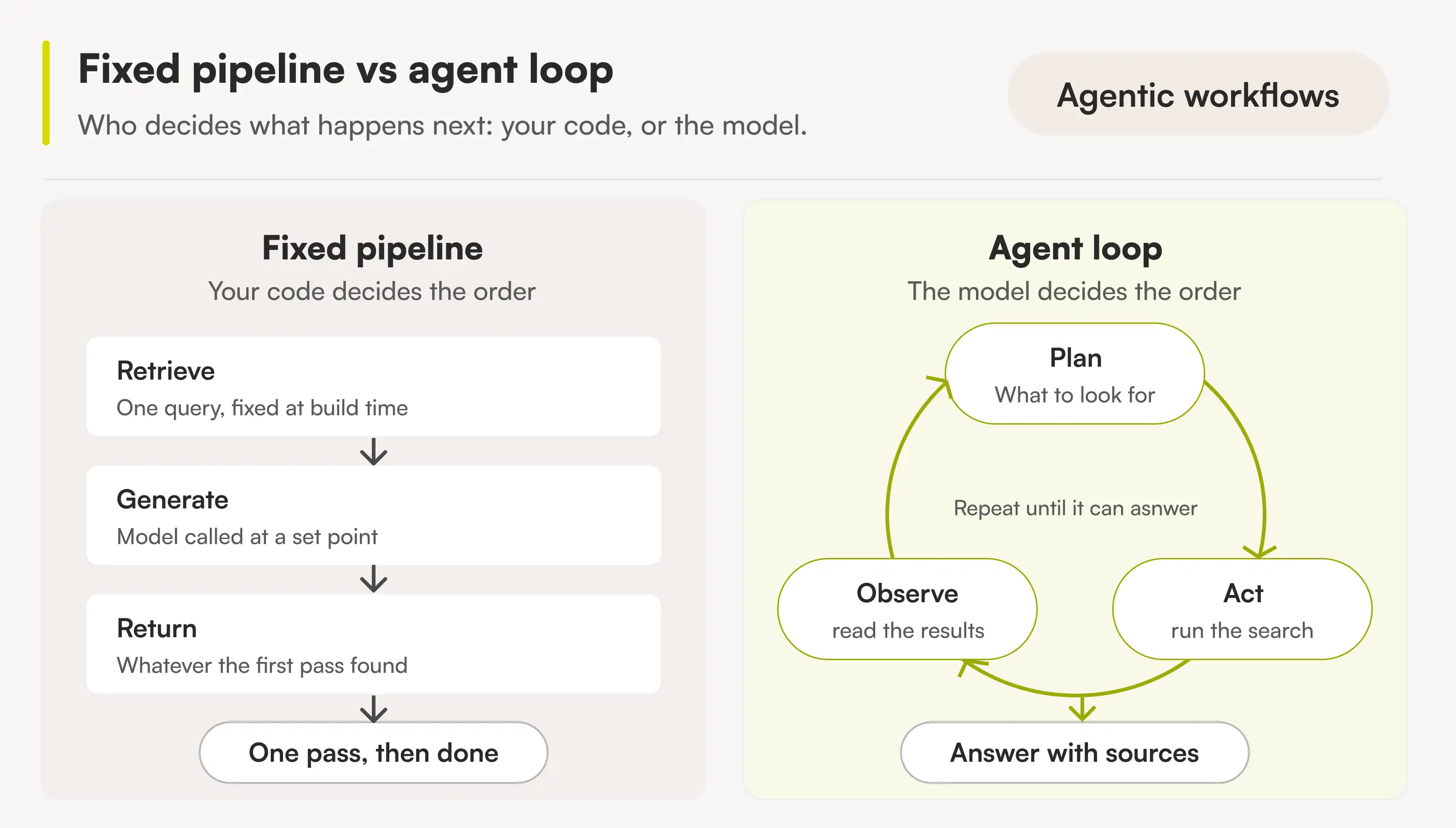
Agentic AI workflows are systems where a language model decides - at runtime - which tools to call, in what order, and when to stop. The model is the planner, the executor, and the judge of its own output. A traditional AI pipeline is the opposite: a developer writes the steps in code, the LLM is called at fixed points, and the orchestration is hardcoded. The pattern was formally introduced in the ReAct paper by Yao et al. (2022), which proposed interleaving reasoning traces and tool-using actions inside a single model loop.
The practical difference shows up in three places: control flow, state, and error handling.
| Dimension | Traditional Pipeline | Agentic Workflow |
|---|---|---|
| Control flow | Fixed sequence in code | Decided by the model at each step |
| State | Function arguments, ephemeral | Persistent graph state, checkpointed |
| Error recovery | Try/except, dead-letter queue | Self-correction, replan, escalate |
| Tool selection | Hardcoded | Chosen from a tool registry |
| Termination | End of script | Model emits a stop signal or hits a budget |
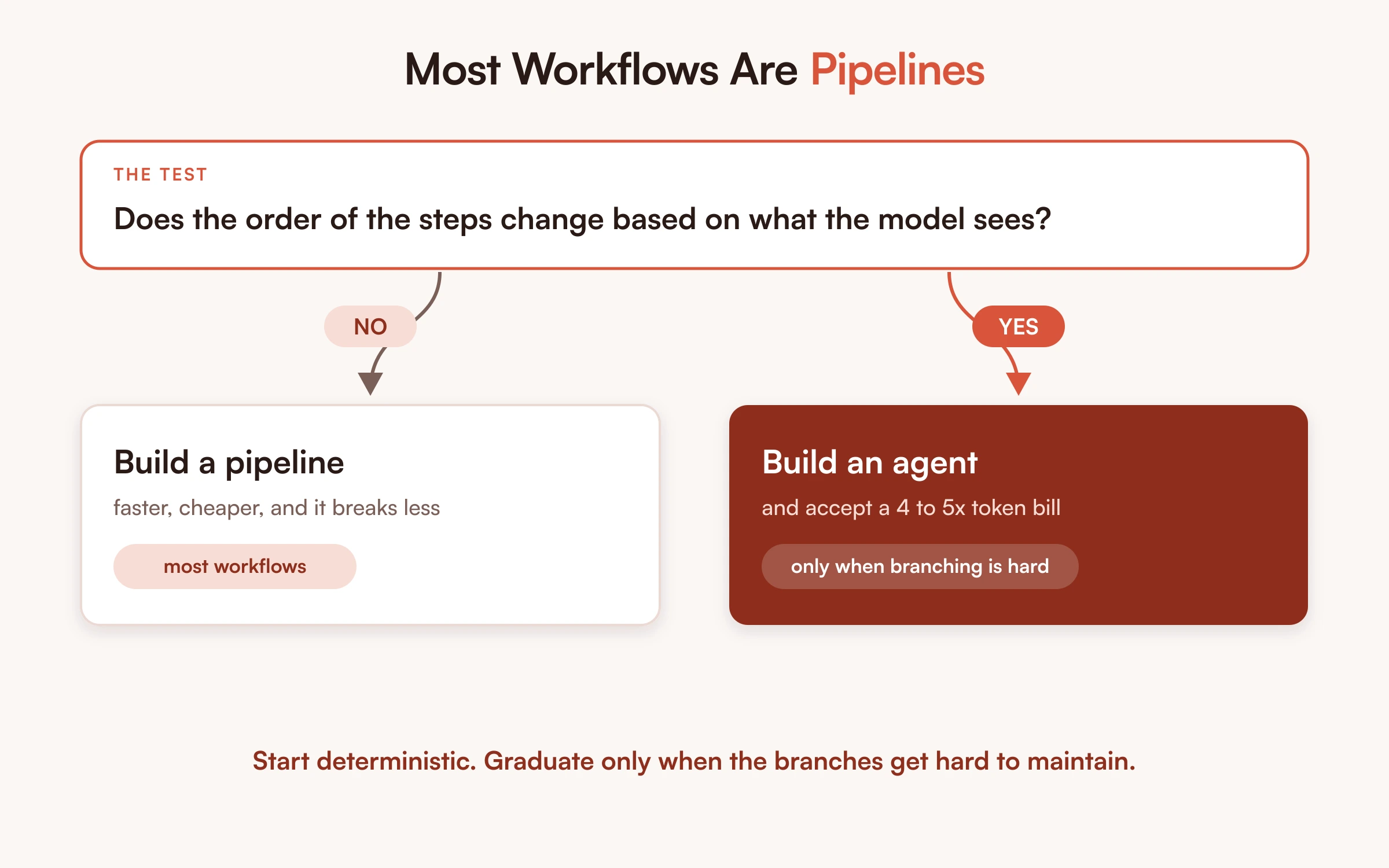
We use a simple test on every project - if the order of steps is the same every time, build a pipeline. If the order changes based on what the model sees, build an agent. Most teams over-index on the agent option because it sounds modern, then discover that 80% of their workflow is deterministic and they paid a 4-5x token bill for the privilege.
The shift to agentic workflows is real, but it is not universal. Order processing, document classification, and most ETL jobs are still pipelines. Patient triage, customer support routing, legal research, and any workflow with conditional branches that depend on content are agentic. The Bitontree default is to start deterministic and graduate to agentic only when the branch logic gets too complex to maintain in code. For those deterministic, high-volume workloads we ship as part of our AI automation development practice, where rule-based and AI-augmented pipelines remain the right tool for the job.
The Core Architecture of an Agentic Workflow
An agentic workflow has six components that must be designed together - model, tools, memory, orchestrator, observability, and guardrails. Skip one and the system either fails silently in production or burns through tokens without finishing. The architecture below is the one we ship by default; it has survived deployments in healthcare, legal, logistics, and B2B sales.
The six components:
1. Model - the planner. GPT-4o, Claude Sonnet 4.5, Gemini 2.5 Pro, or an open-weight model like Llama 3.3 70B served on Together or Fireworks. Pick the model with the best tool-calling reliability for your domain, not the highest benchmark score.
2. Tool registry - typed function definitions the model can call. In production we wrap these as MCP servers so they are reusable across agents. See our MCP implementation guide for the server pattern.
3. Memory - short-term (conversation buffer), long-term (vector store like Pinecone, Weaviate, or pgvector), and structured (Postgres or Redis for entities the agent must remember exactly, like patient IDs or invoice numbers).
4. Orchestrator - the graph runtime. LangGraph for stateful, branching workflows. CrewAI for role-based multi-agent collaboration. A custom state machine for narrow, high-throughput workflows. Hosted, lower-code builders such as OpenAI's AgentKit and its visual Agent Builder fill the same orchestrator role when a team wants a faster starting point, with the same production guardrails still required.
5. Observability - LangSmith, Arize Phoenix, or Langfuse. Without trace-level visibility, every agent failure becomes a 2-hour debugging session.
6. Guardrails - input validation, output schema enforcement (Pydantic, Instructor, or structured output APIs), and a token/cost budget that hard-stops runaway loops.
The mistake we see most often is treating the orchestrator as the whole system. LangGraph is the runtime, not the architecture. The architecture is the contract between these six components - what each can do, what it must not do, and how state flows between them.
Why Agentic Workflows Took Over in 2025-2026
Three changes flipped the economics - tool calling got reliable, orchestration got stateful, and tool protocols got standardized. Before 2025, building an agent meant writing custom retry logic for every tool, hand-rolling state checkpoints, and praying the model did not hallucinate a function name. By mid-2025, those problems had solutions in the open-source stack.
The reliability shift came from frontier models. GPT-4o, Claude Sonnet 4.5, and Gemini 2.5 hit 95%+ tool-calling accuracy on standard benchmarks like the Berkeley Function Calling Leaderboard v3. Earlier models like GPT-3.5 sat around 70-80%, which is unusable in production - one in five calls failing means the agent stalls every five steps.
The orchestration shift came from LangGraph. Stateful graphs with checkpointing meant agents could resume after a crash, route conditionally on output content, and run in a "human-in-the-loop" mode where a person approves specific edges. Before LangGraph, every team rebuilt this primitive from scratch, badly.
The protocol shift came from MCP. Anthropic released the Model Context Protocol in late 2024; by 2026 it is the de facto way to expose tools, resources, and prompts to any model. Instead of wrapping every API in a custom function and re-registering it per agent, we ship one MCP server per integration and reuse it across the portfolio.
Related: MCP Server Development: A Production Implementation Guide - the server pattern we use to wrap every external integration once and reuse across agents.
The combined effect: an agent that took six weeks to ship in 2023 now takes 8-12 days from brief to production. That is the only reason agentic workflows are showing up in production at all - the unit economics finally clear. The market backdrop tracks: Gartner predicts 40% of enterprise applications will feature task-specific AI agents by 2026, up from less than 5% in 2025.
Building a Production Agentic Workflow: Stack and Code
A production agentic workflow needs a graph runtime, a typed tool layer, structured state, and explicit termination conditions. The minimum stack we ship is LangGraph for orchestration, OpenAI or Anthropic SDK for the model, Pydantic for state schemas, and LangSmith for tracing. Anything less and you will rebuild these primitives badly within two weeks.
The example below is a stripped-down version of the routing layer in our medication calling system - the agent decides whether a patient call should proceed to medication confirmation, escalate to a nurse, or reschedule based on the patient's response.
from langgraph.graph import StateGraph, END
from langgraph.checkpoint.postgres import PostgresSaver
from pydantic import BaseModel
from typing import Literal
from openai import OpenAI

client = OpenAI()

class CallState(BaseModel):
    patient_id: str
    transcript: list[dict]
    intent: Literal["confirm", "escalate", "reschedule", "unknown"] = "unknown"
    attempts: int = 0
    escalation_reason: str | None = None

def classify_intent(state: CallState) -> CallState:
    response = client.chat.completions.create(
        model="gpt-4o",
        messages=[
            {"role": "system", "content": INTENT_PROMPT},
            {"role": "user", "content": str(state.transcript[-3:])},
        ],
        response_format={"type": "json_object"},
    )
    parsed = CallState.model_validate_json(response.choices[0].message.content)
    return state.model_copy(update={"intent": parsed.intent})

def route(state: CallState) -> str:
    if state.intent == "escalate" or state.attempts >= 3:
        return "escalate_to_nurse"
    if state.intent == "reschedule":
        return "book_followup"
    if state.intent == "confirm":
        return "log_adherence"
    return "ask_clarifying_question"

graph = StateGraph(CallState)
graph.add_node("classify", classify_intent)
graph.add_node("ask_clarifying_question", ask_clarifying)
graph.add_node("escalate_to_nurse", escalate)
graph.add_node("book_followup", book_followup)
graph.add_node("log_adherence", log_adherence)

graph.set_entry_point("classify")
graph.add_conditional_edges("classify", route)
graph.add_edge("ask_clarifying_question", "classify")
graph.add_edge("escalate_to_nurse", END)
graph.add_edge("book_followup", END)
graph.add_edge("log_adherence", END)

checkpointer = PostgresSaver.from_conn_string(POSTGRES_URL)
app = graph.compile(checkpointer=checkpointer)
Three details matter here. The state is a Pydantic model - the agent cannot wander off-schema. The router is plain Python - the model classifies, the code routes, and the routing logic is auditable. The checkpointer is Postgres - every state transition is persisted, so a crashed call resumes from the last good state instead of starting over.
The full medication calling graph has 14 nodes and runs in production at 200+ patient calls per night with a measured 32% boost in medication adherence - the production version adds retry budgets, ASR confidence thresholds, and a hard escalation rule when the patient mentions specific risk language.
Production Patterns: Loops, Human-in-the-Loop, and Error Recovery
Three patterns separate prototypes from production: bounded loops, human-in-the-loop approvals, and explicit error recovery. Every agent we have shipped uses all three. Skipping any of them creates a system that either runs forever, makes irreversible decisions without oversight, or fails silently when an upstream API changes. Anthropic's Building Effective Agents research documents the same conclusion across their own production work: simple, composable patterns outperform complex frameworks for agentic systems.
Bounded loops mean every cycle in the graph has a hard counter and a token budget. We use two limits - a step counter (max 30 nodes traversed per request) and a token budget (max 50K tokens per session). When either limit triggers, the graph routes to a "budget_exceeded" terminal node that logs the state and returns a graceful failure. Without bounded loops, a confused agent will retry the same tool 200 times and spend $40 on a single request.
Human-in-the-loop is a LangGraph primitive - interrupt_before=["node_name"] pauses the graph at a node and waits for an external signal to resume. We use it for two cases:
- Irreversible actions - sending a patient message, charging a card, filing a legal document
- Low-confidence decisions - when the model's structured output includes a confidence score below 0.7
The agent emits a notification (Slack, email, or in-app inbox), a human approves or rejects, and the graph resumes from the checkpoint. The Singapore invoice processing system uses this pattern - the agent classifies the invoice automatically when confidence is high, but routes to a finance reviewer when the vendor is new or the amount crosses a threshold. Net result was 70% less manual invoice work across the deployment.
Error recovery has three layers. First, every tool call is wrapped with a typed retry - three attempts with exponential backoff for transient errors, zero retries for 4xx errors (those are bugs, not transients). Second, the agent has a self-correction node that runs when a tool returns an error - the model sees the error, decides whether to retry with different inputs, escalate, or give up. Third, every terminal failure writes a structured incident record to Postgres so the on-call engineer can replay the state graph in LangSmith and see exactly what the agent saw. The self-critique loop is grounded in the Reflexion paper by Shinn et al. (2023), which showed that letting an agent reflect on failed attempts and adjust subsequent reasoning improves task success rates.
How Do You Observe and Debug Agentic Workflows in Production?
Observability for agentic workflows requires trace-level visibility into every node, tool call, and state transition - standard application logging misses 80% of what matters. We instrument every agent with three layers: a tracing platform like LangSmith or Arize Phoenix, structured state logs to Postgres, and a metrics layer for cost and latency per workflow type. Without all three, debugging is guesswork.
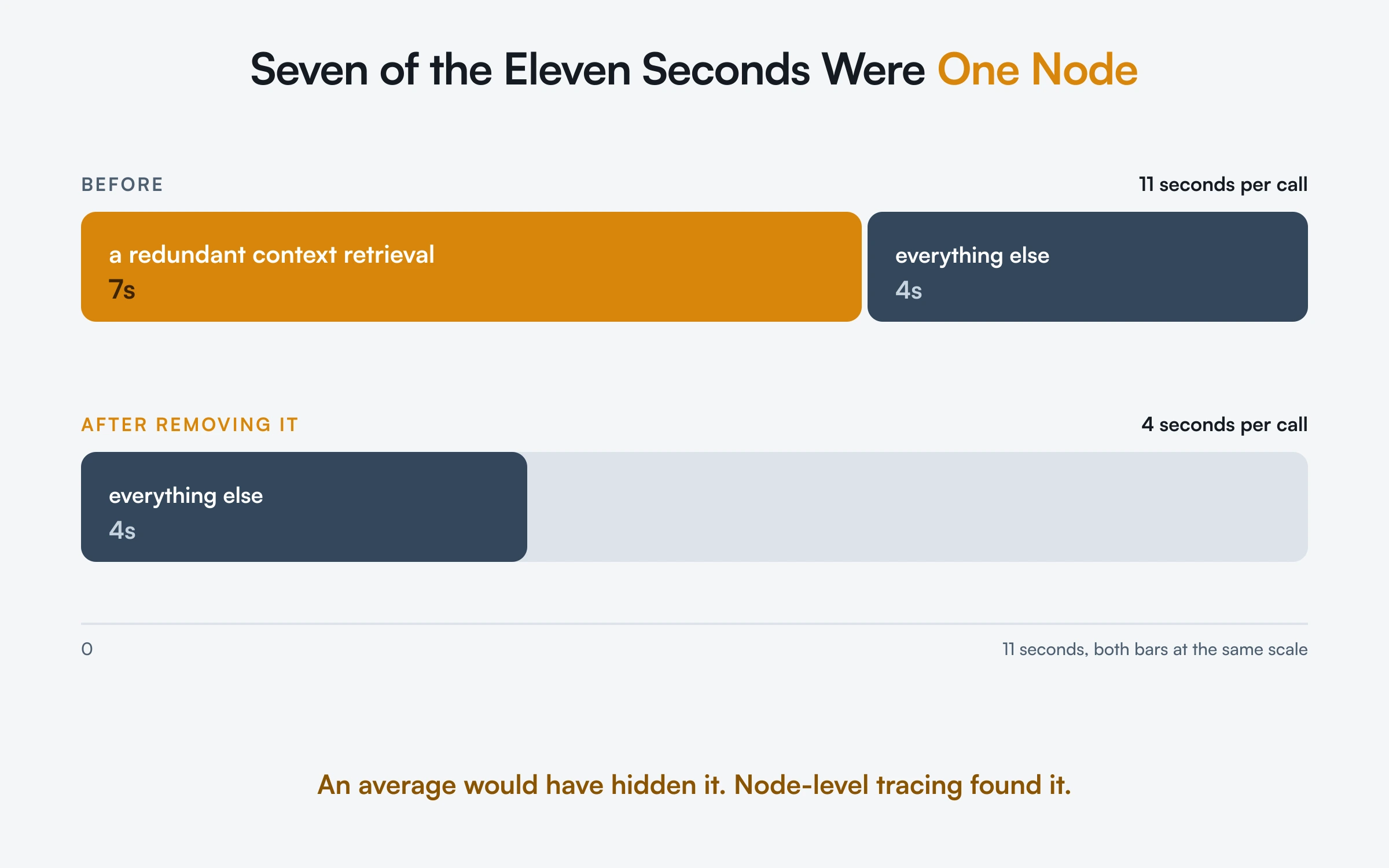
The single most useful metric is node-level latency distribution. Most agents are slow in one specific place - a tool that times out, a model call with too much context, or a retry storm - and the p95 latency at each node tells you exactly where. The medication calling system was originally averaging 11 seconds per call; node-level tracing showed that 7 seconds was spent in a redundant context retrieval step. Removing it cut latency to 4 seconds without changing call quality.
The second most useful metric is tool error rate by tool name. When an upstream API degrades or changes its schema, the agent does not crash - it just fails more often. A dashboard of tool error rates per day catches these regressions before users notice.
Standard observability stack for a Bitontree agent in production:
- Tracing - LangSmith (paid) or Langfuse (open-source self-hosted) for full graph traces
- Metrics - Prometheus + Grafana for cost-per-request, p50/p95/p99 latency, tool error rate, escalation rate
- State logs - Postgres or Redis Streams; every state transition writes a record with the patient/case ID, node name, timestamp, and a hash of the state
- Alerts - PagerDuty or Slack alerts on tool error rate > 5%, escalation rate > 2x baseline, or cost per request > 1.5x baseline
The cost dimension matters more than teams expect. An agent that costs $0.12 per call in November can cost $0.31 in February because the model started generating longer chains. Without a per-workflow cost dashboard, the bill creeps up invisibly.
When Not to Use an Agentic Workflow
Most "agent" problems are scheduling, RAG, or rule-engine problems in disguise - and an agent is the wrong tool for any of them. We turn down agentic projects regularly because the operational math does not justify the complexity. Three patterns where a deterministic system is the honest recommendation: Gartner predicts over 40% of agentic AI projects will be canceled by end of 2027 due to escalating costs, unclear business value, or inadequate risk controls.
Fixed-sequence workflows: If every input follows the same path - extract, transform, validate, write - build a pipeline. Apache Airflow, Prefect, or a plain Python script will run faster, cost less, and break less often than an agent. We see teams reach for LangGraph when a 50-line script would have shipped in a day.
High-volume, low-variance tasks: Invoice line-item extraction at 10,000 documents per day is a document AI problem, not an agent problem. A purpose-built extraction pipeline using a model like Claude or GPT-4o with structured output, plus a confidence threshold and a human review queue, will be faster and cheaper than an agent reasoning about each invoice.
Strict latency requirements: Anything under 500ms p95 - search ranking, real-time pricing, fraud scoring - should not have an agent in the request path. Use the agent offline to generate rules or training data; serve traffic from a deterministic system.
The honest test we use on every new project - if the team can write the workflow as a flowchart on a whiteboard in 10 minutes, it is a pipeline. If the flowchart has more than three conditional branches per request and the branches depend on natural language content, it is an agent. Most workflows are pipelines.
Real Deployment: Medication Calling at 200+ Patients Per Night
The system that anchors most of our agentic patterns is the medication calling deployment at a mental health clinic in the USA - 200+ patient calls nightly, a measured 32% boost in medication adherence, and zero compliance incidents in production. The agent runs on LangGraph with GPT-4o, Twilio for telephony, Deepgram for ASR, and ElevenLabs for synthesis. State is persisted in Postgres; tracing runs through LangSmith.
The workflow has 14 nodes. The agent dials the patient, confirms identity, runs through a script that branches based on the patient's response (confirmation, missed dose, side effects, escalation language), logs adherence to the EHR via FHIR, and escalates to an on-call nurse when the conversation triggers any of the clinical safety rules.
Three architectural decisions made the system work:
1. The agent does not decide what to say verbatim - it picks from a library of clinically reviewed prompts. The freedom is in routing and disambiguation, not in language generation. This was a hard constraint from the clinical team and we agreed; an LLM generating its own clinical language is unacceptable risk.
2. Every state transition is checkpointed in Postgres - a dropped call resumes the next attempt at the last good state, including which medications were already discussed.
3. Escalation is a one-way edge - once the agent escalates, the nurse owns the call. The agent does not de-escalate, retry, or override.
This is not a generic agent. It is a narrow, well-instrumented agentic workflow with clinically reviewed scripts and a tight tool registry. That narrowness is the point - agentic does not mean unbounded.
Where to Start With Agentic AI Workflows
The takeaway from every agentic system we have shipped is the same - narrow the scope, name the stack, instrument every node, and treat the agent as one component in a designed system rather than the system itself. Most production failures we have debugged trace back to an over-broad agent definition or missing observability, not model limitations. If you are evaluating agentic ai workflows for a specific operational problem and want a second opinion on architecture, Book a Free AI Fit Assessment and we will tell you honestly whether the problem warrants an agent or a pipeline.

I am the founder and CEO of Bitontree, where I lead embedded AI engineering teams that build and run production AI: agents, RAG and knowledge systems, document AI, and workflow automation for healthcare, logistics, legal, and SaaS companies. I write about what it actually takes to ship AI that survives contact with production.
Frequently Asked Questions
What is an agentic workflow?

An agentic workflow is a system where a language model decides at runtime which tools to call, in what order, and when to stop, instead of following a sequence a developer hardcoded. The model acts as the planner, the executor, and the judge of its own output. In production, agentic workflows run on a graph runtime with persistent state, typed tools, and explicit termination conditions. That runtime, not the model, decides when the work is finished.
What is the difference between single-agent and multi-agent workflows?
A single-agent workflow is one language model with a tool registry making all the decisions, while a multi-agent workflow splits the work across several agents that each own a role and hand off to one another. Single agents are simpler to build, cheaper to run, and easier to debug, so they are the right default for most narrow problems. Multi-agent setups make sense when the task genuinely divides into distinct roles, for example a researcher agent feeding a writer agent, which is where a role-based framework like CrewAI fits. More agents means more coordination overhead, so add them only when a single agent cannot hold the whole job.
How is an agentic workflow different from a traditional AI pipeline?
An agentic workflow lets the model decide the order of steps at runtime, while a traditional AI pipeline runs a fixed sequence a developer wrote in code. In a pipeline the LLM is called at set points and the orchestration is hardcoded, so the same input always follows the same path. In an agentic workflow the path changes based on what the model sees, state is persisted across steps, and the model can replan or escalate on failure. Our test on every project is simple: if the order of steps is the same every time, build a pipeline; if the order changes based on content, build an agent.
What is an agentic AI pipeline?
An agentic AI pipeline is a workflow that mixes deterministic pipeline stages with agentic decision points, rather than being purely one or the other. In practice most production systems are hybrids: fixed steps handle the parts that never change, and an agent handles the branches that depend on natural language content. We start deterministic and graduate a stage to agentic only when its branch logic gets too complex to maintain in code. Calling something a pipeline or an agent is less useful than asking which stages actually need runtime reasoning.
What is an agentic runtime?
An agentic runtime is the orchestration layer that executes an agentic workflow, holds its state, and enforces when it stops. In our stack that runtime is a graph engine like LangGraph, which persists state between steps, checkpoints every transition so a crashed run resumes from the last good state, and routes conditionally based on the model output. The runtime is also where the hard limits live, such as a step counter and a token budget that force termination. A key design rule is that the model never decides whether to keep going; the runtime does.
Can you show an agentic workflow example?
A clear agentic workflow example is our medication calling system, which runs 200+ patient calls per night on a 14-node LangGraph graph. The agent dials the patient, confirms identity, runs a clinically reviewed script that branches on the response (confirmation, missed dose, side effects, or escalation language), logs adherence to the EHR, and hands off to an on-call nurse when a safety rule triggers. The model classifies intent and the plain-Python router chooses the next node, so every routing decision is auditable. This narrowness is the point: agentic does not mean unbounded.
How do I build an agentic workflow with LangChain?
To build an agentic workflow in the LangChain ecosystem, most teams reach for LangGraph, which is built by the LangChain team and uses LangChain primitives internally. LangGraph gives you the stateful graph, checkpointing, and conditional routing that a production agent needs, while LangChain provides the model wrappers and tool abstractions underneath. The minimum stack we ship is LangGraph for orchestration, the OpenAI or Anthropic SDK for the model, Pydantic for state schemas, and LangSmith for tracing. Start with a typed state model and explicit stop conditions before you add nodes.
What is OpenAI's workflow builder or AgentKit?
OpenAI's workflow and agent tooling lets you assemble tool-using agents on top of OpenAI models without hand-rolling every orchestration primitive yourself. Whichever builder you use, the same production requirements apply: typed tools, persisted state, bounded loops, and human-in-the-loop checkpoints for irreversible actions. A visual or hosted builder shortens the first prototype, but the architecture decisions that keep an agent reliable are identical to the ones we make in code. Pick the tooling that fits your team, then hold it to the same guardrails you would demand of any production agent.
How is an agentic workflow different from a chatbot?
A chatbot generates responses; an agentic workflow takes actions. A chatbot calling an LLM to answer a question is conversational AI, while an agent that books an appointment, sends a message, queries a database, and escalates to a human based on what it finds is agentic. The defining feature is autonomous tool use against external systems with real consequences. If nothing changes in the outside world when the model runs, you have a chatbot, not an agent.
What is the difference between an agent and an agentic workflow?
An agent is a single LLM with tools, while an agentic workflow is a system of agents, tools, state, and orchestration logic. A workflow often has multiple model calls, branching paths, and human-in-the-loop checkpoints wired together on a runtime. A solo agent is fine for simple tool use; production systems are almost always workflows. Treating the orchestrator as the whole system is the most common mistake we see, because the architecture is really the contract between the model, tools, memory, orchestrator, observability, and guardrails.
What is the best framework for building agentic workflows in 2026?
LangGraph is the production default for most stateful, branching agents. CrewAI is better for role-based multi-agent collaboration, and AutoGen is strong for research and experimentation. For narrow, high-throughput workflows we sometimes build a custom state machine in plain Python because the framework overhead is not worth it. The right choice depends on workflow shape and team familiarity, not benchmark scores.
How do you prevent agents from getting stuck in loops?
Use bounded loops with hard counters and token budgets. Every cycle in the graph carries a step counter (we use 30 nodes max per request) and a token ceiling (50K per session). When either triggers, the graph routes to a terminal budget-exceeded node, logs the state, and returns a graceful failure. The model never decides whether to stop; the runtime does. Without this, a confused agent will retry the same tool hundreds of times and burn real money on a single request.
When should I NOT use an agentic workflow?
Skip the agent when the workflow has a fixed sequence, when latency must be under 500ms, or when volume is high enough that deterministic processing is cheaper. Order processing, document classification, and most ETL jobs are pipelines, not agents. The honest test we use: if you can draw the workflow as a flowchart in 10 minutes, you do not need an agent. Most "agent" problems are scheduling, RAG, or rule-engine problems in disguise.
Can agentic AI workflows be HIPAA-aware?
Yes, with the right architecture. Run on a BAA-covered model provider (Azure OpenAI, AWS Bedrock, or Google Vertex AI), keep PHI out of trace logs by redacting before instrumentation, run the workflow inside a HIPAA-eligible cloud account, and apply standard controls such as encryption, audit logging, and access reviews. Our medication calling system runs under a BAA with these controls in place. HIPAA-aware architecture is a design decision you make up front, not something you bolt on afterward.